Force Metal Industries offers buttweld fitting solutions for industrial requirements, with a focus on product quality, dimensional accuracy, and dependable performance.
Our manufacturing unit is based in Ahmedabad, Gujarat, India.
Buttweld fittings are specially designed pipe components that are joined directly to pipes through butt welding.
This creates a strong and permanent connection that supports smooth fluid or gas flow throughout the pipeline.
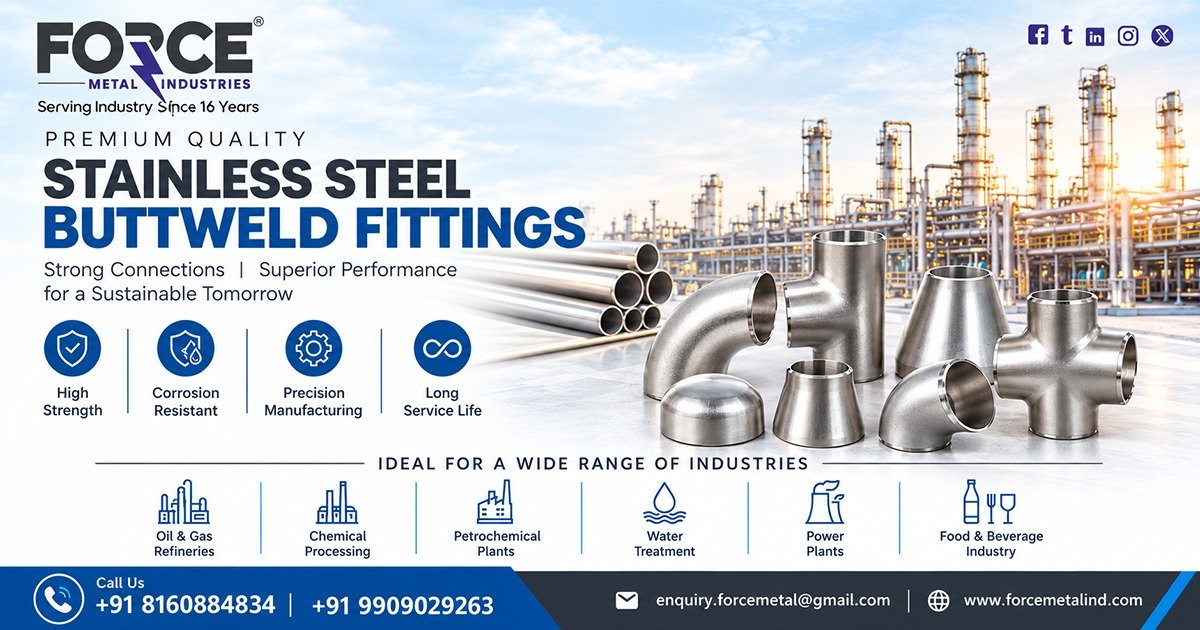
These fittings are available in different shapes, sizes, thicknesses, and material grades to suit various industrial applications. Common types include elbows, tees, reducers, caps, crosses, and stub ends.
For businesses looking for dependable buttweld fittings in Madhya Pradesh, selecting the correct material, size, schedule, and fitting type is essential for achieving a safe and long-lasting piping system.
How Buttweld Fittings Improve Piping Operations?
Choosing suitable buttweld fittings can improve the performance and reliability of industrial pipelines.
- Strong Connections: Welding creates a permanent joint that can provide dependable structural integrity.
- Reduced Leakage Risks: Properly prepared and inspected welds help minimise potential leakage points.
- Efficient Fluid Movement: Smooth internal transitions can reduce unnecessary turbulence and flow resistance.
- Long Service Life: Correct material selection helps fittings withstand their intended operating environment.
- Design Flexibility: Different fitting configurations make it easier to develop complex pipeline layouts.
- Lower Maintenance Requirements: Properly installed fittings can reduce the need for frequent joint-related maintenance.
Working Process: From Product Selection to Final Installation
A properly planned installation helps buttweld fittings perform effectively throughout their service life.
- Requirement Assessment: Identify the pipeline purpose, operating pressure, temperature, fluid type, and installation environment.
- Fitting Selection: Choose the required elbow, tee, reducer, cap, or other fitting according to the piping layout.
- Material Verification: Select a suitable material grade based on corrosion exposure and operating conditions.
- Pipe End Preparation: Clean, align, and prepare the pipe and fitting ends for welding.
- Welding Operation: Join the fitting and pipe using an approved welding procedure and qualified personnel.
- Inspection and Testing: Conduct visual, dimensional, and other required non-destructive or pressure tests according to the project specification.
- Final Installation: Complete the pipeline inspection and verify that the connection meets applicable engineering requirements.
Where Buttweld Fittings Deliver Industrial Value?
Buttweld fittings are used in several industries that depend on well-connected piping networks.
- Oil and Gas Industry: Used in pipelines, processing facilities, and fluid transportation systems.
- Chemical Processing Plants: Suitable for process lines handling chemicals and industrial fluids, with appropriate material selection.
- Power Generation: Used in steam, cooling water, and auxiliary piping systems.
- Petrochemical Refineries: Support pipeline connections in processing and distribution units.
- Pharmaceutical Industry: Used in process piping where the selected material meets hygiene and corrosion-resistance requirements.
- Food and Beverage Industry: Suitable for compatible processing lines and utility connections.
- Water Treatment Plants: Used in water distribution, treatment, and industrial utility networks.
- Manufacturing Units: Help connect pipelines supplying compressed air, water, and other process fluids.
Frequently Asked Questions:
1. What are buttweld fittings used for?
Buttweld fittings are used to connect pipes, change pipeline directions, create branch connections, and adjust pipe diameters in industrial piping systems.
2. Which types of buttweld fittings are available?
Common types include 45-degree elbows, 90-degree elbows, 180-degree elbows, equal tees, reducing tees, concentric reducers, eccentric reducers, caps, crosses, and stub ends.
3. Which materials are used to manufacture buttweld fittings?
They are available in stainless steel, carbon steel, alloy steel, duplex steel, and other special alloys, depending on application requirements.
4. Which industries use buttweld fittings?
Oil and gas, chemical, pharmaceutical, petrochemical, power generation, food processing, refineries, and water treatment industries commonly use these fittings.
We supply Buttweld Fittings in Madhya Pradesh including locations Indore, Bhopal, Jabalpur, Gwalior, Ujjain, Sagar, Dewas, Satna, Ratlam, Rewa, Katni, Singrauli, Burhanpur, Morena, Khandwa, Bhind, Chhindwara, Guna, Shivpuri, Vidisha, Chhatarpur, Damoh, Mandsaur, Khargone, Neemuch, Pithampur, Narmadapuram, Itarsi, Sehore, Betul, Seoni, Datia, Nagda, Shahdol.
For more information and inquiries, feel free to contact us.
Website:www.forcemetalind.com
Call Us:+91 8160884834 | +91 9909029263
Mail Us:enquiry.forcemetal@gmail.com | info@forcemetalind.com
View Product: Click Here